

A football playbook rarely becomes too complicated all at once. It happens one useful idea at a time.
A coach sees a useful formation on Saturday. An opponent shows a pressure that demands a new protection. By midseason, the offense has accumulated more formations, tags and checks than the players can confidently execute.
Every addition may make sense on the whiteboard. Together, they can make the offense slower on the field.
The answer is to build around a small number of concepts that players can recognize and run from many different looks. Mesh, Flood, Stick and Flat-Read provide a useful foundation because each stresses the defense differently—and each can become a family of offensive football plays.
Why Most Football Playbooks Become Too Complicated
Coaches naturally prepare for problems. When a defense presents a new front, coverage or pressure, the instinct is to add an answer. The trouble begins when every answer becomes a separate play with its own terminology and rules.
Players then learn the offense as a list of instructions. When the formation changes or the defense rotates after the snap, that memorized picture disappears. Hesitation follows.
A simpler football offense does not ask less of players. It teaches them more deeply. When players understand spacing, leverage and the purpose of a concept, they can recognize the same idea even when the formation around it changes.
That is the difference between memorizing a play and learning a system.
Start With Concepts Instead of Plays
A play tells 11 players what to do. A concept explains how key assignments work together and which defender the quarterback is reading.
Instead of installing a new play every time the presentation changes, a coach can dress the same concept in a new formation, personnel grouping or motion. The defense sees something different. The offense sees familiar spacing and the same read.
Four concepts are not literally four calls. They are four organizing ideas. Each can generate multiple variations while preserving the rules players already know.
The Best Offenses Are Built Around Ideas
Patrick Mahomes, Matthew Stafford and Brock Purdy do not play quarterback the same way. Their coaches do not build offenses the same way, either.
Andy Reid gives Mahomes structure with room to improvise. Sean McVay uses condensed formations and motion to help Stafford identify leverage. Kyle Shanahan makes different plays begin with similar formations and backfield action, allowing Purdy and Christian McCaffrey to play fast while the defense sorts through possibilities.

Different pro QBs like Mahomes, Stafford, and Purdy benefit from conceptual foundations.
These are not simple offenses. But their complexity is organized.
The players repeatedly encounter familiar concepts, reads and route relationships. The defense encounters changing formations, motion, personnel and tempo. One side recognizes the pattern. The other has to diagnose it in real time.
That is the real objective of a concept-based playbook:
Give the defense more to process without giving your players more to remember.
The Four Concepts That Can Build an Entire Offense
Mesh
Mesh uses shallow crossing routes to create natural traffic and separation, especially against man coverage. Paired with complementary routes, it can also give the quarterback answers against zone.
Run from condensed sets, spread formations and different personnel groupings, Mesh becomes a reusable structure for attacking defenders across the field. Learn the Mesh concept.
Flood
Flood stretches one side of the defense vertically. A deep route, an intermediate route and a route to the flat force zone defenders to cover three levels with limited numbers.
The quarterback sees how the defense distributes coverage, while formations and movement can change how the stretch is created. Study the Flood concept.
Stick
Stick gives the quarterback a fast, efficient answer by creating a simple read near the line of scrimmage. The stick route and the route to the flat place an underneath defender in conflict: widen, and the inside receiver finds space; sit inside, and the ball can go outside.
The concept is compact and easy to pair with other ideas, making it valuable whenever the offense needs the ball out quickly. Review the Stick concept.
Flat-Read
Flat-Read turns the movement of a flat defender into the quarterback’s answer. Two routes work together to threaten that defender inside and outside, creating a clean either-or decision.
The routes may change, but the logic remains consistent. Once players understand the read, coaches can build related calls without starting over. See the Flat-Read family.
Together, these four concepts attack man coverage, stretch zone coverage horizontally and vertically, and give the quarterback defined reads. More importantly, they give the offense a common language.
How to Turn Four Concepts Into Dozens of Offensive Plays
The offense gains variety through presentation, not constant reinvention. A coach can expand each concept by changing:
- Formation: Run it from 2×2, 3×1, empty, bunch or condensed alignments.
- Personnel: Use receivers, tight ends and backs to create different matchups within the same structure.
- Motion: Reveal coverage, improve leverage or change who becomes the conflict defender.
- Alignment: Move a route closer to the formation or widen it without changing its job.
- Tags: Adjust one route to answer a specific coverage while leaving the core read intact.
- Tempo and situation: Present the concept differently on third down, in the red zone or during a two-minute drive.
To the defense, these can look like different offensive football plays. To the offense, they remain familiar. That balance allows a system to be multiple without becoming bloated.
How to Make a Football Playbook Players Actually Learn
If you are deciding how to make a football playbook, begin with the way players will retrieve information under pressure—not the way diagrams are easiest to file.
Organize the playbook by concept or read family, then show its formations and variations. Use the same name for the same job everywhere it appears.
That structure becomes visible in Football Lab. Fairfield Flag Football’s team playbook is organized into four concept folders—Flat-Read, Flood, Mesh and Stick—with multiple plays stored inside each family. Players do not encounter one long list of disconnected calls. They see the relationships first.
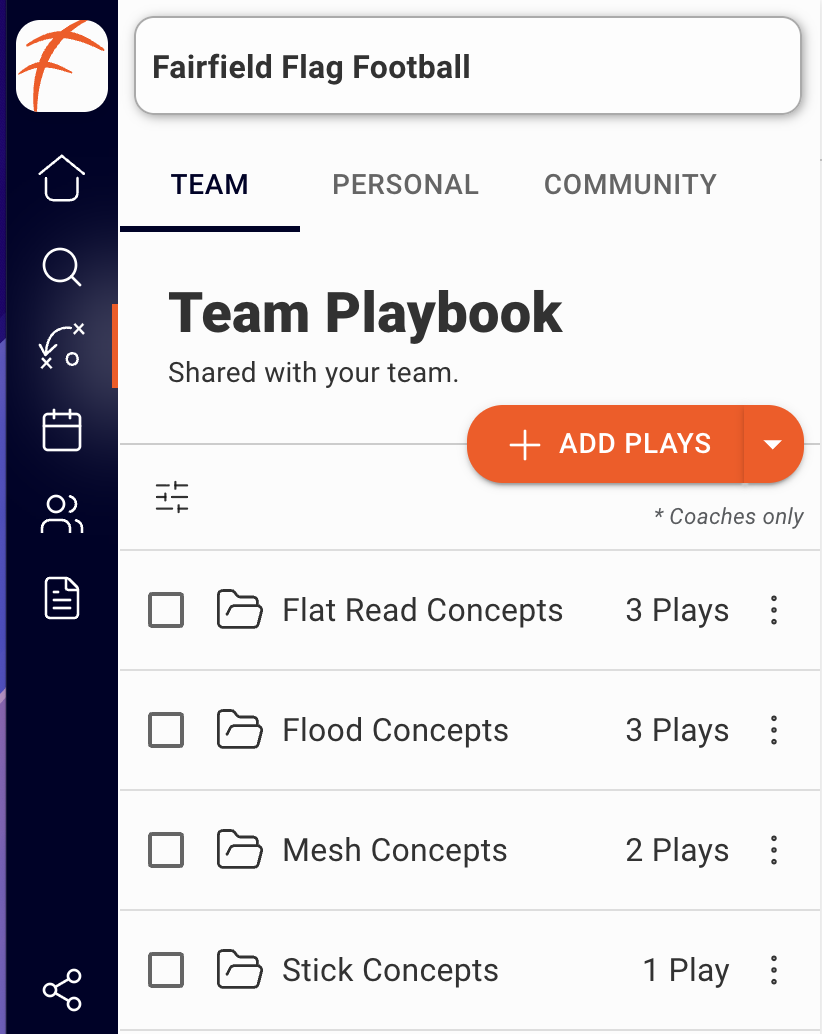
Fairfield Flag Football organizes related plays into four concept families inside Football Lab.
- Introduce the concept and explain the defensive problem it solves.
- Teach the spacing, timing and quarterback progression.
- Show the same concept against multiple coverages on film.
- Rep the base version before adding formations or tags.
- Review mistakes by returning to the concept’s rules.
The playbook should be the shared reference connecting meetings, film and practice.
Building a System That Scales Over Time
A concept-based offense can grow without asking players to relearn its foundation. Coaches can add a motion, formation or coverage adjustment while preserving the core read.
This also makes the system easier to evaluate. If a variation fails, the staff can ask whether the problem was the concept, the presentation or the execution. The playbook becomes clearer because every addition has a place and a purpose.
The strongest football playbook is not necessarily the one with the most answers. It is the one that allows players to find the right answer quickly—and execute it with confidence.
Build your playbook digitally with Football Lab. Organize concepts, teach players faster and simplify your coaching process in one place.
Frequently Asked Questions
What is a football playbook?
A football playbook is a collection of formations, concepts, assignments and situational strategies that helps coaches organize and teach their system.
How do you make a football playbook?
Start with a small number of core concepts, define the rules and reads for each one, and then build variations through formations, motion and personnel. Organize the material so players can see how related plays fit together.
What should be included in a team playbook?
A team playbook should include formations, concepts, responsibilities, quarterback reads, coaching points, terminology and situational strategies.
How many offensive football plays should a team have?
There is no universal number. A handful of well-taught concepts can create dozens of calls through different formations and adjustments.
Why do concept-based offenses work?
Concept-based offenses help players understand spacing, reads and defensive leverage. That understanding makes it easier to recognize familiar ideas from unfamiliar looks and play faster.
Can a football offense be effective with only a few concepts?
Yes. An offense can create substantial variety by running a small number of concepts from multiple formations, personnel groupings and motions. The key is to master the underlying rules before adding variations.